
Durham County Court Records After Arrest
The Durham arrest-to-court path starts with booking at the Durham County Detention Facility and continues through the North Carolina court system. The jail roster records a custody event and gives charge descriptions, bond fields, and court docket numbers when available. The formal court record is handled by the Durham County Clerk of Superior Court and the North Carolina Judicial Branch, where case filings, hearing dates, charge changes, dispositions, and bond forfeitures are tracked.
The Durham County District Attorney, Satana Deberry, serves Prosecutorial District 16. The prosecutor may proceed on charges that differ from the first booking description. A charge can be dismissed, amended, reduced, or superseded by indictment. For that reason, a roster charge is a useful starting point, but it should not be treated as the final court outcome. For custody and booking facts, use Durham County jail inmate records. For booking-photo questions, use the Durham County jail mugshots page.
Durham Court Search Sources
The Durham County Records Access page points court users to the eCourts Portal while warning that background checks should go through the clerk's office.
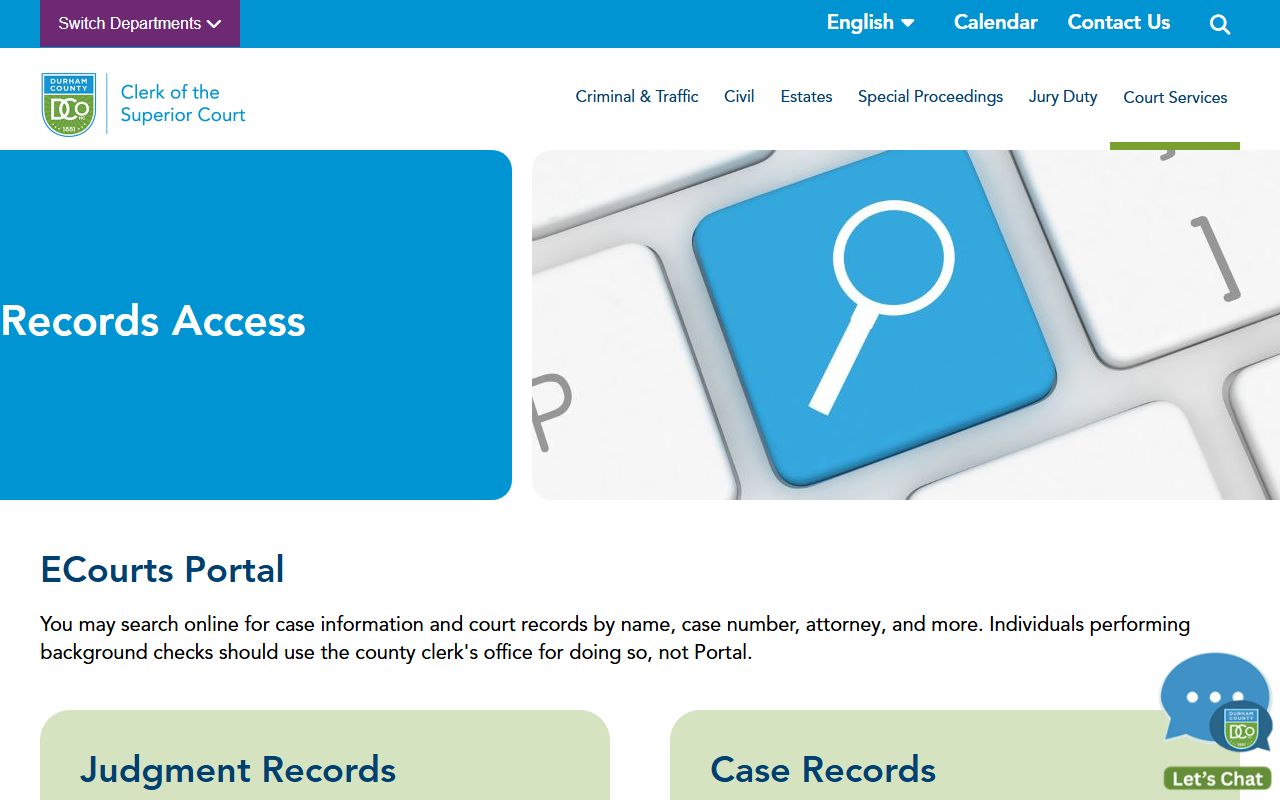
This source supports the main workflow: search online when case information is available, but use the clerk's office for official court-file access and background-check needs.
Find Court Records After Arrest
Durham County's Records Access page says the eCourts Portal can search case information and court records by name, case number, attorney, and more. The North Carolina Judicial Branch also says criminal case information can be accessed at public self-service terminals in clerk offices, with searches by defendant name, case number, victim name, or witness name. A jail roster court docket, when present, is the best bridge from jail booking to court case.
- Check the Durham County jail roster for the person's name, date confined, and Court Docket field.
- Open the N.C. Judicial Branch services page and follow the Portal path for case search.
- Search by defendant name or case number. Use the roster docket when it appears in the jail table.
- Read the case events, charge list, hearing dates, and disposition fields rather than relying on the booking charge alone.
- Visit or call the Durham County Clerk of Superior Court if an official file copy or terminal search is needed.
Durham Court Records Search Fields
The exact eCourts Portal screen can vary by session, but the Durham and state pages identify the main search paths. Public terminals at the clerk's office add victim and witness name search options for criminal case information.
| Field or Channel | Type | Notes |
|---|---|---|
| Name | Portal search | Durham Records Access says case information can be searched by name. |
| Case number | Portal search | Use the Court Docket from the jail roster when available. |
| Attorney | Portal search | Listed by Durham Records Access as an available search route. |
| Defendant name | Public terminal | N.C. court guidance lists defendant-name searches at clerk terminals. |
| Victim or witness name | Public terminal | Available for criminal case information at public self-service terminals. |
Charges Filed After a Durham Arrest
After a Durham County jail arrest, the first charge description may come from a warrant, citation, officer paperwork, or magistrate process. The court record develops as prosecutors file or amend charges. North Carolina cases use different charging documents depending on the case type and stage, and a later indictment can replace or refine earlier charge language.
| Document | Who Uses It | What It Does |
|---|---|---|
| Complaint or warrant paperwork | Law enforcement and magistrate process | Starts many cases near the arrest and booking stage. |
| Information or prosecutor filing | District Attorney | States how the prosecutor proceeds on a criminal charge. |
| Indictment | Grand jury and prosecutor | Formal felony charging document used in superior court cases. |
Durham Charge Status Records
Charge status is the court side of the arrest record. The jail table may continue to show the booking charge while the court file shows later action. A charge can remain pending, be amended, be dismissed, move to a plea, or end in a verdict. The disposition is the court outcome, not the jail booking entry.
| Status | What It Means |
|---|---|
| Pending | The case is open and no final disposition has been entered. |
| Amended or reduced | The charge wording, level, or count changed after prosecutor or court action. |
| Dismissed | The charge ended without a conviction in that case. |
| Convicted or guilty plea | The case ended in a finding or plea that creates a conviction record. |
| Failure to appear | A missed court date may create a new order for arrest or bond issue. |
Bond Records After Arrest
Durham's jail roster shows Bond Type and Bond Amount for each charge row. Observed values included NO BOND, SECURED, UNSECURED, and [N/A]. Some rows with a bond type may still show $0.00, so a single row should not be read as the total release condition. Magistrates located in the detention facility handle many first release decisions, and a judge can revisit conditions at first appearance or later hearings.
| Bond or Hold | How It Works |
|---|---|
| Written promise or recognizance | Release based on a promise to appear and obey court conditions. |
| Unsecured bond | A dollar amount is set but not paid up front unless the person fails to comply. |
| Secured bond | Release requires cash, property, or a surety bond. |
| No bond or hold | Release may be blocked by the charge, a detainer, probation matter, federal hold, or other order. |
Durham Clerk and Court Contacts
The researched court contacts are practical because different offices handle different parts of the record. The Durham County Courthouse and Clerk of Superior Court main number is (919) 808-3000. District Criminal and Traffic Records can be reached at (919) 808-3002 for criminal and traffic court dates, courtrooms, traffic citations, limited driving privilege issues, bond forfeitures, and vehicle seizures. Superior Criminal is listed at (919) 808-3007 for superior court dates, courtrooms, attorney information, bond forfeitures for CRS cases only, and copies of CRS files.
Durham County Court Contacts
Clerk of Superior Court: (919) 808-3000
District Criminal/Traffic Records: (919) 808-3002
Superior Criminal: (919) 808-3007
Magistrates - Criminal Warrants: (919) 560-6826
District Attorney: (919) 808-3010
Warrants Leading to Arrest
A warrant can be the reason a person appears in the Durham County jail roster. The roster may show failure-to-appear charge descriptions and docket numbers after a warrant arrest, but it is not a complete active-warrant database. For missed court, bench orders, criminal warrants, or involuntary-commitment criminal process, the magistrate and clerk contacts are the safer official channels.
DCSO also issued a scam advisory telling residents to verify warrant, fine, or jury-duty claims through the Durham County Courthouse at (919) 808-3000 or the sheriff non-emergency line at (919) 560-0900. That warning is useful for anyone contacted by a caller who demands money to clear a warrant.
Charges vs Convictions
An arrest and a charge are not the same as a conviction. A jail roster row means a custody event and a listed charge or hold. A conviction means the court case ended with a guilty plea, verdict, or other conviction entry. Durham County court records after a jail arrest should be read with that time line in mind.
| Charge | Conviction | |
|---|---|---|
| Stage | Accusation or filed count | Final court result after plea or verdict |
| Where It Appears | Jail roster and court filings | Court disposition and criminal-history records |
| Can Change | Yes, charges may be amended or dismissed | Changes only through later court action |
Sealed and Expunged Arrest Records
North Carolina public-records law starts with broad access to state and local records, but court records after an arrest can be restricted by juvenile rules, sealed orders, expunctions, victim protections, and criminal-investigation limits. Expunction is the court process for eligible records to be removed or restricted under state law. A dismissal alone does not automatically erase every public trace from every system.
| Sealed | Expunged | |
|---|---|---|
| Public View | Restricted from ordinary public access | Removed or treated as cleared under the expunction order |
| How It Happens | Court order or protected case category | Eligible petition and court order under North Carolina law |
| What To Check | Clerk's office and case file | Clerk's office, attorney, or official expunction guidance |
Restricted Court Records After Arrest
N.C. G.S. 132-1.4 protects criminal-investigation and criminal-intelligence records, even though certain arrest information is public. N.C. G.S. 132-6 requires inspection and copies at reasonable times, but lawful exceptions still apply. Juvenile records, sealed files, protected witness information, and expunged matters should not be expected to appear in a public case search.
Important: A public case lookup is not a consumer report and should not be used for employment, housing, credit, or insurance screening.